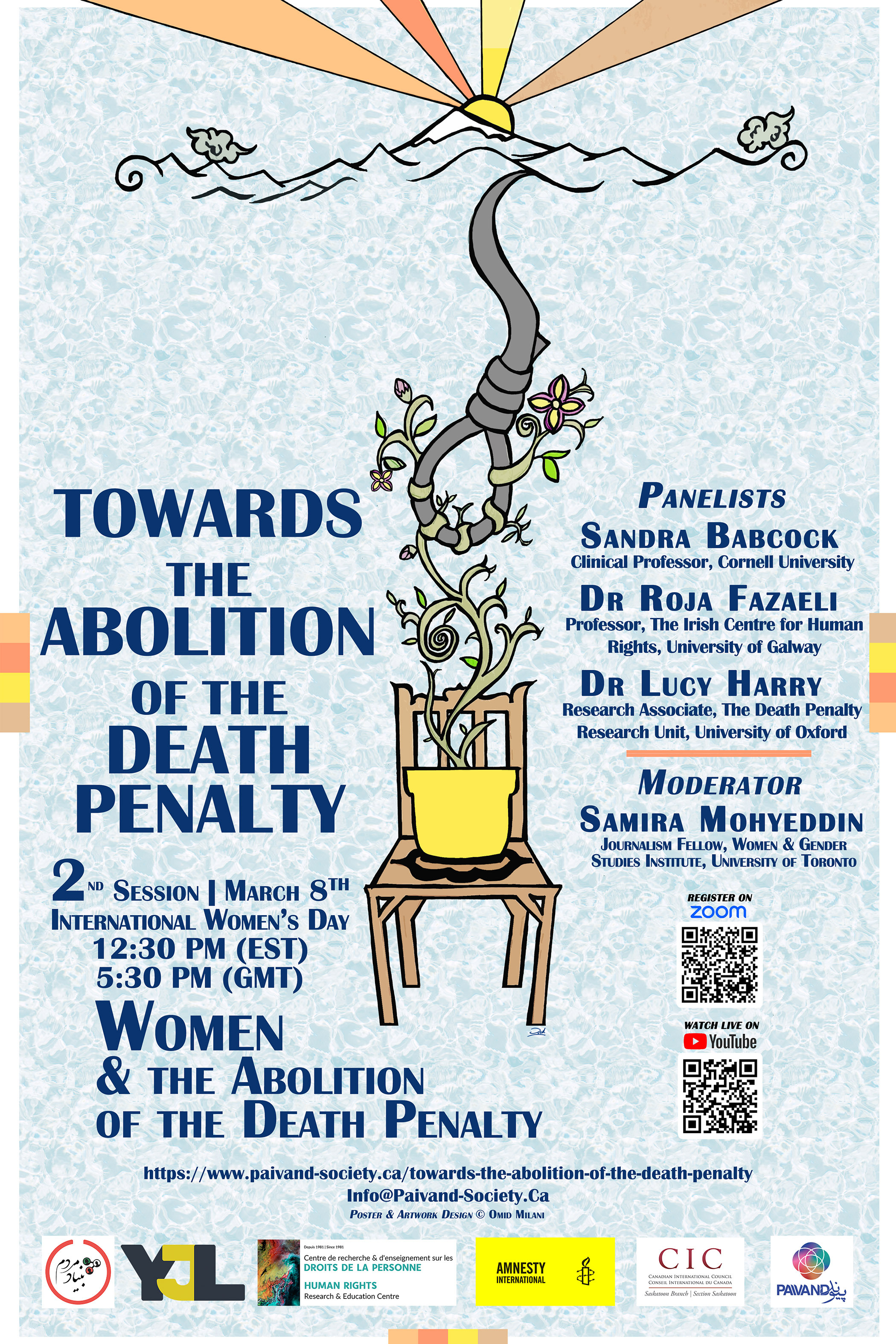
You are invited to a special online event on International Women’s Day
March 8th, 2025 – 11:30 am- 1:30 pm Saskatchewan time (12:30- 2:30 pm EST): Women & the Abolition of the Death Penalty
If you missed this event you are able to watch the recording https://www.youtube.com/watch?v=_nPZPqeErKE
Theme:
Statistics tell us that women are executed at lower rates than men. While true on the face of it, recent research says that these numbers are severely under-reported.
When all the factors of discrimination against women by ‘male-dominated systems’ are considered, including laws that minimize a woman’s voice, cultures that degrade ethnic minorities, religions that silence women, societies that make light of domestic abuse and other crimes of violence against women, no-one should be surprised that the state is often the driving force behind the suffering of women and girls. Which remains an untold story.
The regimes that kill women don’t boast about it, and traditional reporting doesn’t pay it much attention.
This is changing. Women are leading the way.
As Professor Milani points out, women are playing an ‘undeniable leading role in the abolition of the death penalty, not least through … cultivating power dynamics in both private and public spheres’, and challenging the use of state violence to maintain social order.
Our second webinar will hear from three women. They are not merely scholars and writers, they are profoundly successful in advancing the fundamental rights — to life, safety, security, equality before the law — of women and girls around the world.
Moderator

Samira Mohyeddin, Journalism Fellow, Women and Gender Studies Institute, University of Toronto, is an award-winning journalist, producer, food expert, and trained Shakespearean actor. She believes that journalists must uphold the highest standards of their profession in holding powerful people to account.
Panellists

Sandra Babcock is the faculty director of the Cornell University Center on the Death Penalty Worldwide. As a human rights litigator she secured the release of over 250 prisoners in Malawi including 150 facing the death penalty, while playing a pivotal role in creating the Malawi Resentencing Project. She has received Mexico’s highest honour for a citizen of a foreign country — the Agula Azteca award — for her legal counsel to the Government of Mexico in cases of Mexican nationals facing the death penalty in the US. Presently she represents women facing the death penalty in the US, Malawi, and Tanzania.

Roja Fazaeli is the ‘Established Professor of Law and Islamic Studies’ at the Irish Centre for Human Rights, University of Galway. She has worked for Amnesty International Irish Section and taught Islamic civilizations at Trinity College Dublin. She is widely published on the issues of women’s rights in Iran, human rights and religion, Islamic feminisms, and hate in society. During a 2004 research trip to Iran, where she was born, she was placed under house arrest and subjected to daily interrogations.

Lucy Harry is a Research Associate of the Death Penalty Research Unit (DPRU) at the University of Oxford. She has published her research into cases of women who have been sentenced to death as drug couriers in Malaysia and the Gulf States, where drug syndicates, human traffickers, and law enforcement treat women (intersecting as migrants, racialized minorities) as ‘disposable’.
Be sure to register in advance for this event: Go to: https://us02web.zoom.us/w/82320300648?
Or: Use the QR codes on the poster for Zoom or to watch live on YouTube.
This is the 2nd in a 10-part series. If you missed the 1st event you can still watch it on youtube https://www.youtube.com/watch?v=cg2Nic08SvM
Stay tuned for the story of Pakhshan Azizi

Ms Azizi is a Kurdish-Iranian social worker who worked for ten years in refugee camps in northeastern Syria helping women and children recover from the trauma they had suffered at the hands of ISIS. She was arrested in August 2023, and charged months later with ‘armed insurrection against the Islamic Republic of Iran’. Her trial in June 2024 lasted two days. A month later she was given a death sentence. Her lawyers issued an appeal, which the Supreme Court rejected a month ago. Her execution date is unknown but imminent.
Amnesty International and dozens of other human rights groups, as well as legal, journalist, academic, and women’s organizations, are doing everything in their power to get her freedom.
Partners
Amnesty International Canada | English Speaking https://amnesty.ca/
Carleton University Youth & Justice Lab https://carleton.ca/law/youthandjusticelab/
The Human Rights Research and Education Centre https://www.uottawa.ca/research-innovation/hrrec
The Canadian International Council | Saskatchewan Branch https://thecic.org/saskatoon/
The Mardom Foundation https://mardomfoundation.org/
The Paivand Society https://www.paivand-society.ca/
This Series is Presented by ‘United Against Executions in Iran/Unis contre les exécutions en Iran’
We are a network of Iranian-Canadian and Amnesty Canada groups and supporters. Our goal is the abolition of the death penalty in Iran. Our methods include public education initiatives, advocating non-partisan conversations in Parliament, urging more effective actions by the Government of Canada, joining forces with networks like ours in North America and beyond, and persuading local organizations to speak out – to act out – on this urgent issue.
Ending executions in Iran will be a giant step in abolishing the death penalty everywhere.
 Amnesty International Saskatchewan